Three related stories grabbed my attention while waiting for a plane to take me to Boston, which turns out to be the opposite direction from California. First, five Chicago-area breweries have closed in the last six weeks as economics asserts itself:
Alarmist Brewing & Taproom in Sauganash permanently closed Feb. 1, and not long after, Berwyn’s Flapjack Brewery and Forest Park’s Casa Humilde turned off their taps. Two more are shutting down: Whiner Beer Co. in Back of the Yards will close March 29, and Illuminated Brew Works in Norwood Park will close June 28.
A steady decline in drinking is partially to blame. The U.S. drinking rate reached historic lows in 2025, according to data from Gallup. But the recent string of local closings was accelerated by rising operational and production costs, including aluminum tariffs, and what many feel is an oversaturated market, owners said.
Besides game and trivia nights, concerts and other concerted efforts to get people in the door, breweries are raising their prices to match inflation and trying to market to younger and more health-conscious consumers with alternative products, such as THC- and CBD-infused beverages.
Not all of the news is horrible. The city's black-owned breweries have embedded themselves in their communities, to some success:
Leaning into cultural celebration is one way Moor’s [Brewing] and Funkytown Brewery — the city’s two Black-owned breweries — set themselves apart in a volatile industry that is seeing increased brewery closings nationwide. In Chicago, at least five have shuttered or announced closures this year amid rising operational and production costs and a decline in the U.S. drinking rate.
By contrast, Moor’s Brewing and Funkytown Brewery have remained resilient due to contract brewing — producing their beers at other breweries instead of opening a brick-and-mortar location right away. They also have built a following by pairing their beer with cultural experiences and events, and targeting a diverse consumer base. The owners say they hope this approach will sustain them when they eventually open their own space.
Funkytown Brewery was founded five years ago by Rich Bloomfield, Greg Williams and Zack Day. It has spent the last five years operating at beverage incubator Pilot Project Brewing in Logan Square. It plans to open its own facility in 2027 on the Near West Side thanks in part to a $3.7 million Community Development Grant from the city.
Cannabis companies have also taken big hits, except for the one I own shares in. So to me, this counts as great news:
Chicago’s Green Thumb Industries reported $114.1 million in net income last year, making it a stark outlier in an Illinois cannabis market where competitors continue to hemorrhage cash.
Five of the so-called multistate operators in Illinois — New York-based Ascend Wellness, Connecticut-based Curaleaf, Massachusetts-based MariMed, and Chicago-based Cresco Labs and Verano Holdings — lost a cumulative $761 million last year, underscoring the strain for an industry facing regulatory uncertainty.
Ascend, Cresco, Curaleaf and Verano each have 10 dispensaries in Illinois, while MariMed has five. Outlier GTI has 12 dispensaries in Illinois and a national footprint in 14 states.
President Donald Trump signed an executive order a week before Christmas last year that instructs the Department of Justice to move marijuana to Schedule III, which would nullify the impact of 280E on marijuana businesses nationwide and save the industry as a whole billions of dollars in tax payments.
But since Trump’s order in December, there has been zero movement by the DOJ to actually reschedule cannabis. It’s not clear when or if the reclassification will be finished, given that the process was first started under President Joe Biden, but stalled out in 2024 amid pushback from the Drug Enforcement Administration.
Of course the OAFPOTUS's DoJ has done nothing about this; he's decimated the agency. Yet another reason to do whatever it takes to get him out of office before he does more damage to the country and the world. I'm surprised any intoxicant companies are doing poorly with him in office.
Pinned posts
- About this Blog (v5.0) (2 weeks)
- Brews and Choos project (2 months)
- Chicago sunrises, 2026 (2 months)
- Inner Drive Technology's computer history (2 years)
- Logical fallacies (6 years)
- Other people's writing (5 years)
- Parker Braverman, 2006-2020 (5 years)
- Style sheet (8 months)
- Where I get my corn-pone (1 month)

Remember how, earlier today, I posted a smug little note about missing all the horrible weather coming through Chicago tomorrow, because I would be in southern California?
Wouldn't you know, Chicago TRACON cancelled my flight for capacity management. After several attempts to re-route on the American Airlines app, I finally talked to a real person, who got me on the best available alternative. I will now leave tomorrow afternoon for Boston, then fly not to Santa Ana as originally intended, but to LAX, arriving just before midnight.
Oh, it gets better. The conference hotel where I'm staying is 20 km and 28 minutes from SNA, but 61 km and an hour from LAX. Maybe it'll be less than an hour at midnight?
Also keep in mind, midnight in LA is 2am in Chicago. So Tuesday should be a real hoot! At least the time change works in my favor as I can sleep until about 9am Chicago time and still make it to breakfast and the opening session. I will miss a couple of important meetings tomorrow, however.
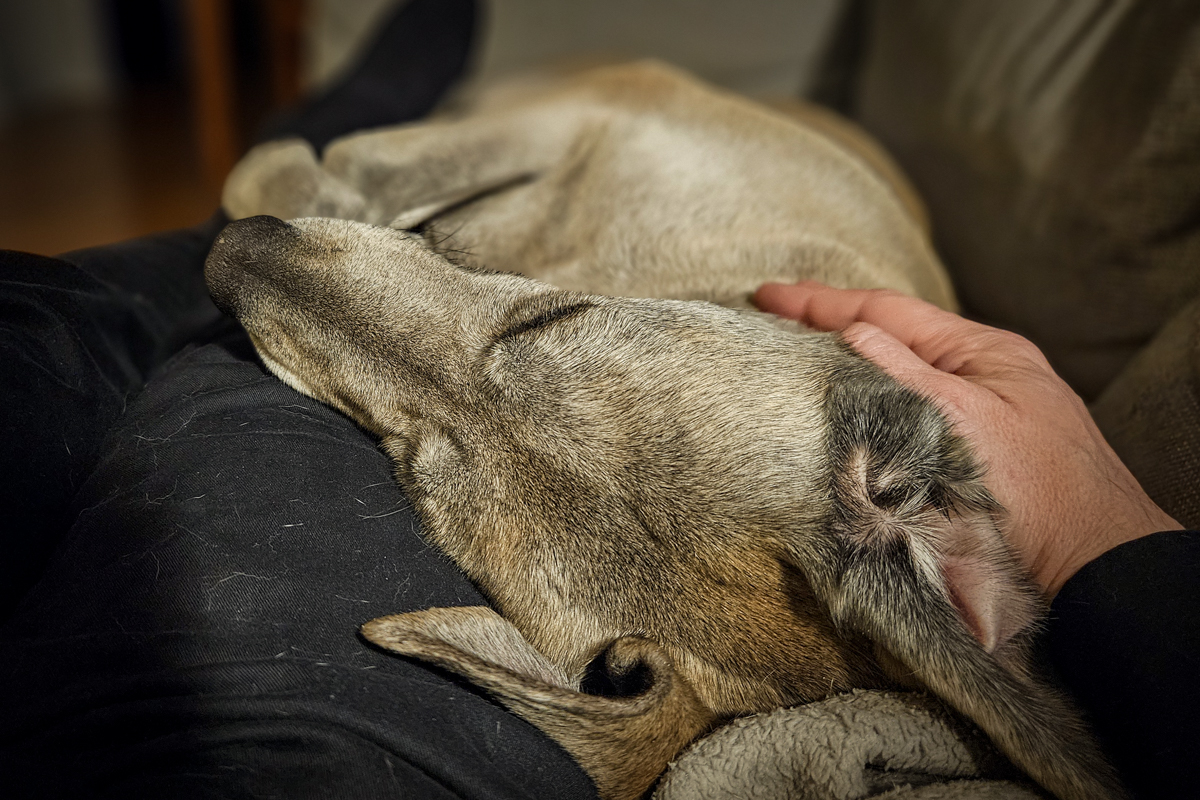
And there is one real silver lining: tomorrow is Cassie's Gotcha Day. I felt sad about missing it, but it turns out, I'll be home with her for part of it!
Yesterday's performance of Bach's St Matthew Passion was absolutely amazing. I know it's long, and with our 90-minute dinner break it actually lasted over 4½ hours, but I'm sad people left after part 1. I've been posting on social media that they should have stayed to see the twist ending (He escaped!).
Unfortunately, with the 3pm call, travel time, and Beer Choir after the concert, I was out for 10 hours, got home at 11:30, and didn't fall asleep until 1:30. (Cassie had relief well before I got home.) I'm bloody knackered.
Today I have nothing but chores as my house hits the market later this week. Meanwhile, we're looking at this forecast with some trepidation:
Monday: Sunny, with a high near 26. Light southwest wind becoming west 10 to 15 km/h in the morning.
Monday Night: Mostly clear, with a low around 14. West wind 10 to 15 km/h becoming light after midnight.
Tuesday: Sunny, with a high near 29. Light and variable wind becoming west 10 to 15 km/h in the morning.
Tuesday Night: Mostly clear, with a low around 16.
Wednesday: Sunny, with a high near 28.
Wednesday Night: Mostly clear, with a low around 15.
Thursday: Sunny, with a high near 28.
Sorry, just kidding. That's the forecast for where I'm traveling to this evening. Chicago's forecast looks like this:
Monday: Snow showers likely, mainly before 1pm. Patchy blowing snow. Cloudy, with a temperature falling to around -5 by 5pm. Windy, with a west northwest wind 45 to 50 km/h, with gusts as high as 70 km/h. Chance of precipitation is 70%. New snow accumulation of 2 to 4 centimeters possible.
Monday Night: A 20 percent chance of snow showers before 1am. Cloudy, then gradually becoming partly cloudy, with a low around -9. Wind chill values as low as -17. Blustery, with a west northwest wind 35 to 40 km/h decreasing to 25 to 30 km/h after midnight. Winds could gust as high as 55 km/h.
Tuesday: Mostly sunny, with a high near -2. West northwest wind 15 to 20 km/h, with gusts as high as 30 km/h.
Tuesday Night: Snow showers likely, mainly after 1am. Mostly cloudy, with a low around -5. Chance of precipitation is 60%.
Wednesday: A 20 percent chance of snow showers before 1pm. Partly sunny, with a high near 6.
Wednesday Night: Mostly cloudy, with a low around 2.
Thursday: Mostly sunny, with a high near 10.
Next post probably from O'Hare this evening. Or at least after my nap.
That's the question I asked myself as I headed off to a 3½-hour rehearsal yesterday evening. The answer, of course, is that I voted, walked Cassie for 90 minutes, fielded an emergency at work despite it being a day off, and dealt with half a dozen smaller things around the house.
Today, all I have is a three-hour performance of Bach's St Matthew Passion, plus getting to and from Elmhurst (about an hour each way), plus a freaking nap. At some point I'll post something of substance—if I have time today.
In a post yesterday, I implied that Defense Secretary Pete Hegseth has admitted having unnatural relations with a piece of furniture. That was incorrect; Vice President JD Vance was the member of the administration alleged to have had the sectional assignation. Hegseth is the one with Nazi tattoos.
The Daily Parker regrets the error.
A colleague at my day job poked around on the Daily Parker, not for the content, but for the software. I now have two more Jira cases.
First, he uncovered a bug in how the app handles the + character in URLs, so that entering a direct link to a tag works fine if you click on the tag, but not if you enter the link itself (https://www.thedailyparker.com/Tags/How+this+works). The problem is in the encoding of spaces; this URL works fine: https://www.thedailyparker.com/Tags/How%20this%20works. This is now Jira case JOUR-444.
He also suggested that he's not really interested in politics, but he does like the technical contents of the blog. This implies a feature where a user can exclude posts that contain a specific tag, rather than find all the posts with that tag. Not sure how to implement it yet, but it's now Jira case JOUR-445.
Also floating around the software discussions at work was a really well-done demo of the most important security bugs in a lot of .NET applications. I'll be sure to check that out when I have free time again in about a week and a half.
My house looks weird
A photographer is coming to my house tomorrow so we can list it on Tuesday. To prepare for this, I've removed about 30 boxes of stuff from the house, mostly books and movies, plus some bookcases and other furniture. Just now after lunch, I removed or put away most of the things I use daily in the kitchen and took everything off the fridge. The house looks great for real-estate photos but it doesn't really feel like my house anymore. Even my normally-cluttered office looks spartan.
Meanwhile:
- Defense Secretary Pete "Cushions" Hegseth does not like unflattering photos of himself, though somehow he doesn't mind when reporters publish the actual words he says out loud.
- Speaking of stupidity, the Defense Department continues its war on intelligence, both the human and artificial kinds.
- They also cut the Civilian Protection Center of Excellence, an internal DoD office tasked with limiting civilian casualties and avoiding targeting mistakes like the one that killed over 100 schoolgirls on February 28th.
- Matthew Yglesias understands that no one wants a quagmire in Iran, but can't see how the war we started there will go any other way.
- Adam Kinzinger wants to know why the department spent $15.1 million on ribeye steak last September while cutting the $20 million required to keep our RC-26B counter-terrorism aircraft flying.
Sorry, I hadn't planned on highlighting just how idiotic our Defense Department had gotten under Hegseth. Here, let's look at two more stories that have nothing to do with how badly our government is run under this administration:
- Two really good breweries, Half Acre and Maplewood, have announced they are merging to reduce materials costs and "amplify founder-led brands."
- The New York Times Magazine explores the world of "Sync Music," which you hear all the time and have no idea why.
OK, back to the mines. Which are eerily uncluttered and depersonalized this afternoon...
A monopoly on competence
We are being governed by unserious people.
The OAFPOTUS's demented adventure in Iran has exposed for people, including those who otherwise wouldn't care, that the Republican Party has given up any pretense of competent governance. They acted out a pantomime of competence for about 30 years, starting when Newt Gingrich shoved the party hard to the loony right in 1994, and even managed to cover it up with a sheet of tracing paper during the OAFPOTUS's first term. Alas, in the last 14 months it has broken free like the chest-bursting end to Kane at breakfast. Just as many of us predicted.
Michael Tomasky enumerates "how we're all paying the price for the myth of Trump's competence:"
We’ve seen numerous examples in these last 13 months of Trump’s mendacity and malevolence. Unfortunately, a lot of Americans will never see him that way. There are those who adore him unconditionally, but beyond these dead-enders, there are others who know he’s not a good person but aren’t all that bothered by it.
That’s hard for millions of us to accept. But I hope to God that these people are finally starting to move themselves toward the conclusion that, even if they aren’t that troubled by the mendacity and malevolence, the man is just wildly incompetent. A mountain range of mythmaking has gone into creating the Trump persona over the years; by him, by a pliant business press in his real estate days, and, since he entered politics, by a right-wing media that would make the old Soviet press agencies blush and a party of cowardly sycophants, most of whom know very well that he shouldn’t be in charge of a high-volume McDonald’s, let alone the executive branch of the federal government, but would rather let the country collapse than say so.
James Fallows, who worked in the Carter Administration during the Iranian Revolution of 1979, and who has written books about Iran and the defense of the US, smacks the OAFPOTUS for "the arrogance of ignorance:"
This has seemed in a way worse than the immediate aftermath of the 9/11 attacks. Or of the multiple horrific assassinations of the 1960s. Those previous tragedies were things done to America. Now the people at the controls have taken every hard-earned lesson about war and peace and set it ablaze.
The strongest leaders in our history have projected strength through control and calm. Think of John F. Kennedy, during the world’s closest brush with nuclear annihilation, the Cuban Missile Crisis, in 1962. Think of Martin Luther King Jr’s bearing, as his influence expanded and the mortal threats to him increased.
Then think of the clowns and posturers who now have the controls. They don’t know what they don’t know. They have no idea what they are unleashing. It took years for the United States to get into its quagmire in Vietnam. It took many months to prepare the groundwork for the disaster in Iraq.
These people have changed the world, for the worse, in just nine days. And none of us knows how it will end.
Historian Francis Fukuyama reminds us that "expecting Iran to unconditionally surrender is a fool's errand:"
When Trump launched the attack with Prime Minister Netanyahu of Israel, he was obviously hoping for a quick victory, something like the outcome he achieved when he snatched Nicolás Maduro of Venezuela in January. But the war expanded across the Middle East, with Iran shooting missiles and drones at American allies and bases all over the Persian Gulf. It was clear that what remained of the Iranian leadership was not about to capitulate, and that the conflict could drag on—as Trump himself admitted—for weeks.
Normally, a smart leader in such a situation would try to lower expectations and declare an achievable objective in the war, such as degrading the better part of Iran’s ability to strike targets with ballistic missiles and drones. This would offer an opportunity for Trump to declare victory and disengage. Instead, Trump did the opposite.
Iran ... is a very big country, and has a lot of places for the surviving regime to hide. It will not be possible to eliminate every missile and drone under their control, so we can expect continuing attacks on U.S.-aligned Gulf states and American facilities into the foreseeable future. The threat of a random drone striking the big airline hubs in the Gulf will be economically very damaging.
[D]emanding unconditional surrender was a very foolish thing for the president to do. I’m tempted to believe that Trump just liked the sound of the words, without thinking through the ways in which they could come back to haunt him. But this was only one poor decision among many. The most serious was the decision to go to war in the first place without a clear rationale for doing so.
Iraq War veteran and former Republican US Representative Adam Kinzinger, saddened by his party's implosion into a sad cult, takes umbrage with the meme-ification of the war:
There’s something deeply unsettling about watching the official social media accounts of the White House turn war into entertainment.
Leadership—especially civilian leadership—has a completely different responsibility. Their job is not to hype the fight. Their job is to weigh the consequences of it.
They are supposed to be thinking about diplomacy. Alliances. Long-term strategy. Civilian casualties. Escalation risks. The stability of the region. The lives of American service members who may be asked to execute the orders they give. And they are supposed to communicate the gravity of those decisions to the American people.
Instead, what we’re getting looks like a social media account run by someone trying to win the internet for the day.
If the United States is going to commit military power against a country like Iran, the American people deserve more than memes and shifting talking points. They deserve seriousness. They deserve honesty. And above all, they deserve a president who understands that war isn’t content.
It’s responsibility.
Glenn Kessler weighs the cost of never admitting error:
Video evidence examined by Bellingcat, The New York Times, The Washington Post, The Associated Press, and other news outlets leaves little doubt that a Tomahawk cruise missile — used only by the United States in the conflict — struck an Islamic Revolutionary Guard Corps base next to an elementary school that was hit at about the same moment, killing mostly children, according to Iranian media reports.
On Monday, Trump again suggested that Iran — or some other country — was responsible.
As U.S. and Israeli missiles continue to rain on Iran’s cities, it’s imperative that any further tragic accidents are thoroughly investigated and the facts made public. Trump often denies reality, but a little humility goes a long way in the court of world opinion.
Getting back to my main point: the OAFPOTUS and his droogs have taken these wildly incompetent actions because the OAFPOTUS and his droogs are wildly incompetent. The apotheosis of this abjectly stupid presidency is a world in which the Democratic Party monopolizes competence at the Federal level. The MAGA cult continues to drive the Party's remaining competence out of state governments, showing that the Party's elites have also lost their minds.
But here we are: in a brand-new land war in Asia, with no rationale for being there and no plausible way to exit gracefully, because the majority party in Congress who also control the presidency and the Supreme Court have an average IQ below the mean and an average maturity level of 7th grade.
It's time to take back the government of the US and put these clowns in a time-out at least until they can demonstrate enough competence and seriousness to run a lemonade stand. I give them about 40 years. Or better yet: throw the Republican Party into the landfill of history, along with the Know-Nothings and other stupid parties whence they came. Let Kinzinger and others like him form a competent center-right party (like Germany's Christian Democrats or Australia's Labour), and let's return to a back-and-forth of ideas about how to govern this country instead of robbing it.
Quick lunchtime links
Spot the thread:
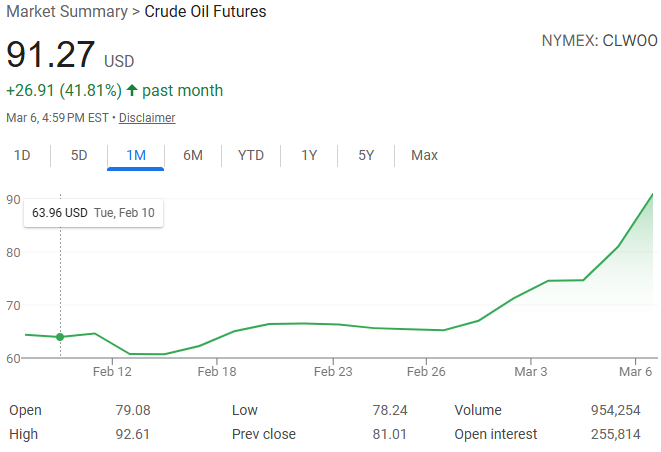
- The OAFPOTUS's adventures in Iran have caused wild gyrations in the oil markets with more expected as the war continues.
- This, in turn, will lead to higher airfares—and soon.
- Will the administration's efforts to increase US oil production help? They will not.
- Climate scientists believe that a "super" El Niño currently forming in the Pacific Ocean could push temperatures to record levels over the next 12-18 months. Because, you will remember, burning oil raises sea surface temperatures.
Unrelated to all of that, the Writers Guild of America released its annual State of the Industry report yesterday. With the entertainment industry contracted, and writers—you know, the people without whom you wouldn't have your entertainment—getting paid less, why are the studios making bank? (Hint: oligopoly.)
The temperature at O'Hare yesterday hit 22.8°C, beating the previous record high by...
(Well, that's interesting. The National Weather Service seems to have removed their Chicago daily temperature records pages. Fortunately the National Centers for Environmental Information has a tool to find the previous record, but this is just another annoying effect of the OAFPOTUS's wanton destruction of our government. I suppose I should build out the climate features on Weather Now before the data goes away entirely...)
Anyway, the previous record was 20.6°C set in 2021, nearly tied by last year's 20°C. Flash forward 18 hours and it looks like a cold front has just passed through:
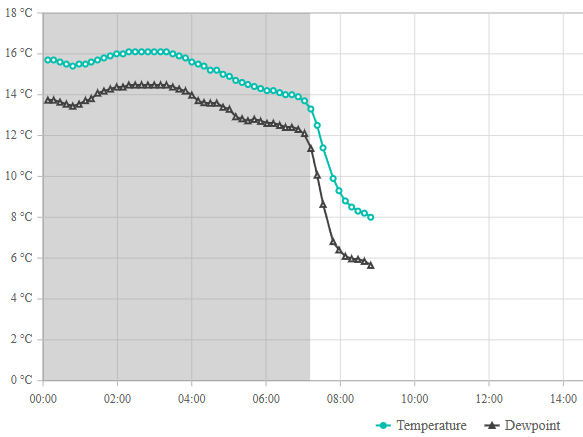
Cassie and I started her morning walk just after 7:30, when the temperature was still 11°C. It was 9°C when we got home 20 minutes later. And now it's around 8°C.
Other than the war with Iran that the OAFPOTUS and his droogs started a week ago, what on earth could have caused this?
Anne Applebaum grits her teeth:
I don’t know what the White House expected when US and Israeli forces began bombarding Iran, but they seem not to have anticipated the global impact of their actions. The Iranian regime did not collapse quickly. Iranian drones and missiles his US bases and consultates, and also damaged civilian targets across the Gulf States, including luxury hotels, airports and energy infrastructure. The result: Hundreds of thousands of tourists and travellers got stuck because of closed airspace. Oil prices skyrocketed upwards. The gas market is in chaos, as the Qatari refinery that produces one-fifth of the world’s supply went offline.
The Chinese and the North Koreans are also watching as American air defenses are used up, and as American allies back away, and making calculations accordingly. So are the Japanese, the Taiwanese and the South Koreans. In the coming weeks, the war in Iran will shape decisions made all across Asia, and around the world. Nobody in the US administration seems to have given much thought to mitigating this kind of collateral damage, let alone the deaths and suffering of civilians in Iran. The attitude is rather let’s drop the bombs and then see what happens.
The war in Iran has profound implications for American politics too. ... Americans should be profoundly concerned about this administration’s inability to explain why the war began, and what the endgame is supposed to be. I hope it ends with a better government in Iran, but so far, again, there is no evidence that either the White House or the Israelis have thought much about that. Instead, the goals and purpose keep changing. Congressional Republicans refuse to exercise any oversight. The public is kept in the dark about important aspects of the war. The secrecy and the dissembling are features of warfare more common to dictatorships than to democracies, where public support is normally needed before a government conducts a war as broad and expensive as this one.
It doesn't help that the OAFPOTUS is an 80-year-old with a family history of Alzheimer's who exhibits symptoms of advanced frontotemporal dementia.
He keeps losing and lashes out by going bigger when he does. How many wars will we fight without any strategy or benefit to the United States before Congress pulls him out of office? I'm afraid we're going to find out.
We got almost up to 16°C today before a cold front pushed through around noon, so the temperature has already fallen to 11°C on its way down to 6°C by sunset.
And then, the rest of the week, we'll bounce around between 20°C with sun on Monday and 4°C with rain on Tuesday.
March always gives us a fun ride. At least the sun is coming out behind the cold front...
On 5 March 2001, Federal judge Marilyn Patel (ND-CA) ordered music-sharing service Napster to remove the copyrighted materials listed in A&M Records' complaint against the service. This effectively killed Napster:
At the peak of Napster’s popularity in late 2000 and early 2001, some 60 million users around the world were freely exchanging digital mp3 files with the help of the program developed by Northeastern University college student Shawn Fanning in the summer of 1999. Radiohead? Robert Johnson? The Runaways? Metallica? Nearly all of their music was right at your fingertips, and free for the taking. Which, of course, was a problem for the bands, like Metallica, which after discovering their song “I Disappear” circulating through Napster prior to its official release, filed suit against the company, alleging “vicarious copyright infringement” under the U.S. Digital Millennium Copyright Act of 1996. Hip-hop artist Dr. Dre soon did the same, but the case that eventually brought Napster down was the $20 billion infringement case filed by the Recording Industry Association of America (RIAA).
That case—A&M Records, Inc. v. Napster, Inc—wended its way through the courts over the course of 2000 and early 2001 before being decided in favor of the RIAA on February 12, 2001. The decision by the United States Court of Appeals for the Ninth Circuit rejected Napster’s claims of fair use, as well as its call for the court to institute a payment system that would have compensated the record labels while allowing Napster to stay in business.
[On] March 6, 2001, Napster, Inc. began the process of complying with Judge Patel’s order. Though the company would attempt to stay afloat, it shut down its service just three months later, having begun the process of dismantling itself on this day in 2001.
Flash forward 25 years, and training large language models with copyrighted material has created new legal problems for authors and users alike.
Homeland Security Secretary Kristi Noem is out:
President Trump fired his embattled homeland security secretary, Kristi Noem, on Thursday and announced plans to replace her with Senator Markwayne Mullin of Oklahoma, after she was grilled by Republican lawmakers this week at congressional hearings on a variety of topics, including her knowledge of a lucrative advertising contract.
Mr. Trump announced the change on social media, along with a new, and previously nonexistent, role for Ms. Noem: special envoy for the Shield of the Americas, which he said would be a new security initiative for the Western Hemisphere.
According to news reports, the OAFPOTUS has nominated US Senator Markwayne Mullin (R-OK) to replace Noem, but with the Senate currently shut down by a debate about funding DHS in the first place, it could be a while before they confirm Mullin.
Sure happy it's Thursday, early March edition
It must be lunchtime:
- Josh Marshall takes a hard look at why ships don't want to traverse the Strait of Hormuz.
- Fully 97% of the 35,000 public comments submitted to the National Capitol Planning Commission about the OAFPOTUS's ballroom are negative.
- Speaking of planning, or lack thereof, Jeff Maurer quotes Jurassic Park to explain how we have no idea what will happen in Iran, but it probably won't be good for us.
Finally, Jaci Clement at the Fair Media Council has some quick tips on how to evaluate a news article in less than 10 seconds. For instance: "First name + last initial byline? Skip it. Credible journalism requires accountability."
Enjoy your Thursday. Tomorrow, Chicago could hit 22°C. Won't that be nice.
The Times had some (not at all) surprising news yesterday:
Studies show that having a pet is associated with lower blood pressure, a reduced risk of cardiovascular disease, and lower rates of death after a heart attack or stroke. And a large review of studies published in 2019 found that owning a dog was associated with a 24 percent lower risk of dying from all causes over the course of 10 years.
The benefit is so striking when it comes to heart health that the American Heart Association even has a scientific statement devoted to it, declaring that dog ownership “may be reasonable for reduction in cardiovascular disease risk.” (The organization doesn’t advise getting a dog for the sole purpose of heart health, though.)
Experts think one potential explanation for the health benefits is that people who own dogs tend to be more physically active than those who don’t.
Or the health benefits of pet ownership may simply be an effect of demographics. Dog owners tend to be younger and richer than non-owners, characteristics that correspond with better health. In one large meta-analysis, when things like age, income and health behaviors such as smoking were factored into the statistical analyses, many health benefits of dog ownership disappeared.
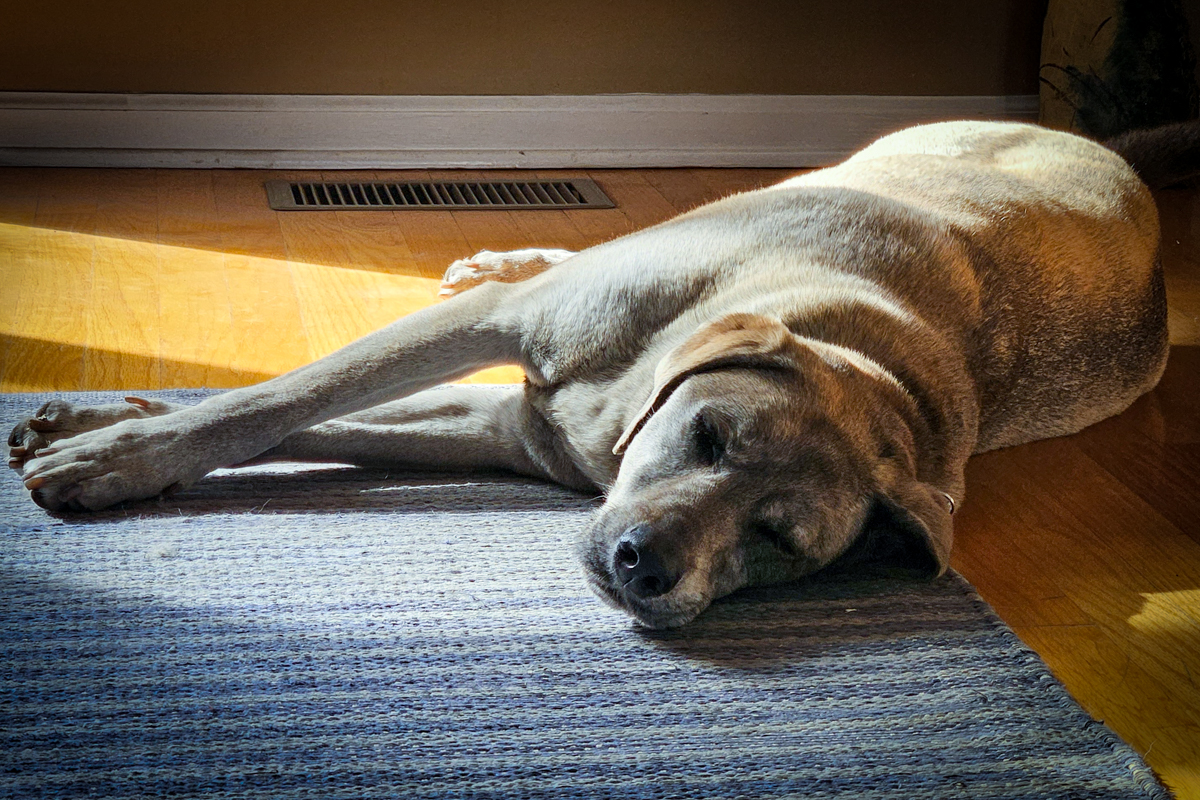
So, don't smoke and adopt a dog. It worked for me! (And for Cassie.)
Day 5 of not knowing WTF we're doing in Iran
I saw a stat on social media that turned out to be true: at its worst, in early 1973, 29% of the US approved of the Vietnam War. But only 27% approve of what we're doing in Iran—or at least, they did on Sunday. Of course, an argument to popularity isn't a valid argument, so let's look at the evidence:
- Part of how this started as the least popular war since polling began: this is not what the OAFPOTUS promised his MAGA stooges, a betrayal that has finally dislodged a handful of them from the cult.
- Because the OAFPOTUS and his droogs lack forethought, planning, competence, and intelligence (the cerebral kind), about 10,000 Americans are stranded in the region.
- This may have something to do with the three major Arabian peninsula airlines (Qatar, Emirates, and Etihad) cancelling 94% of their scheduled operations since Sunday, with all operations in and out of Bahrain halted.
- The war has also halted sea traffic after Iran did what everyone with a triple-digit IQ predicted and blockaded the Strait of Hormuz, causing yet another economic shock that our economy will have to reckon with in short order.
- Not yet a week in, and even conservatives see the OAFPOTUS's hubris, as happens to most ego-driven would-be conquerors over time.
- And let's pause for a moment at how absolutely out of his depth
Jerry LundegaardDefense Secretary Pete Hegseth appears in all this. (Of course, as Maurer says, "Hegseth, Rubio, et. al. can’t be fully candid about our objectives, because the real objective — glorify Trump — is not something the administration can admit.") - What about the Iranian people? Need we even ask?
The only bright spots in the last 24 hours are the election results in Texas, North Carolina, and Virginia, which suggest that the general election in 243 days will go about as well for the Republican Party as this needless and stupid war is going for the UAE, and for exactly the same reasons.
I've got a lot of plates spinning at the ends of sticks for the next couple of days, including figuring out who to vote for in the Illinois Primary Election two weeks from today. Since I won't be in Chicago on election day, I've got to do this by next Friday at the latest. The other spinning plates are a bit bigger.
Instead, today I want to mention that the Federal Aviation Administration has scheduled a meeting for tomorrow with American and United, because the two carriers have way too many operations scheduled at O'Hare this summer. Cranky Flyer explains:
The basic point of the meeting is to figure out how to come up with a schedule that can actually be operated. As the FAA notes, peak days have more than 3,080 daily operations this year compared to only 2,680 last summer. That is not sustainable. This has been an open secret for months now in the wake of American and United bulking up their operations. There was never any chance that all of these flights could operate without serious operational problems. Now the FAA has to figure out how it wants to implement this.
Of course, we don’t know how the FAA will look at this. Will it agree to reductions based on what’s filed? Or will it look at what flew last year, or perhaps pre-pandemic? Chances are American will argue for going back as far as possible while United wants to use this summer. We will know more soon.
Regardless of what happens, United is likely going to still have a very substantial number of flights compared to American when all is said and done. And that had to be the airline’s ultimate goal.
In theory, all the extra departures should be good for travelers' wallets and bad for their experience getting into or out of O'Hare. I have no flights planned for the summer, though I am planning to plan at least four. I'm curious to see how tomorrow's meeting affects those plans.
Copyright ©2026 Inner Drive Technology. Privacy. Donate!