Weekend photos
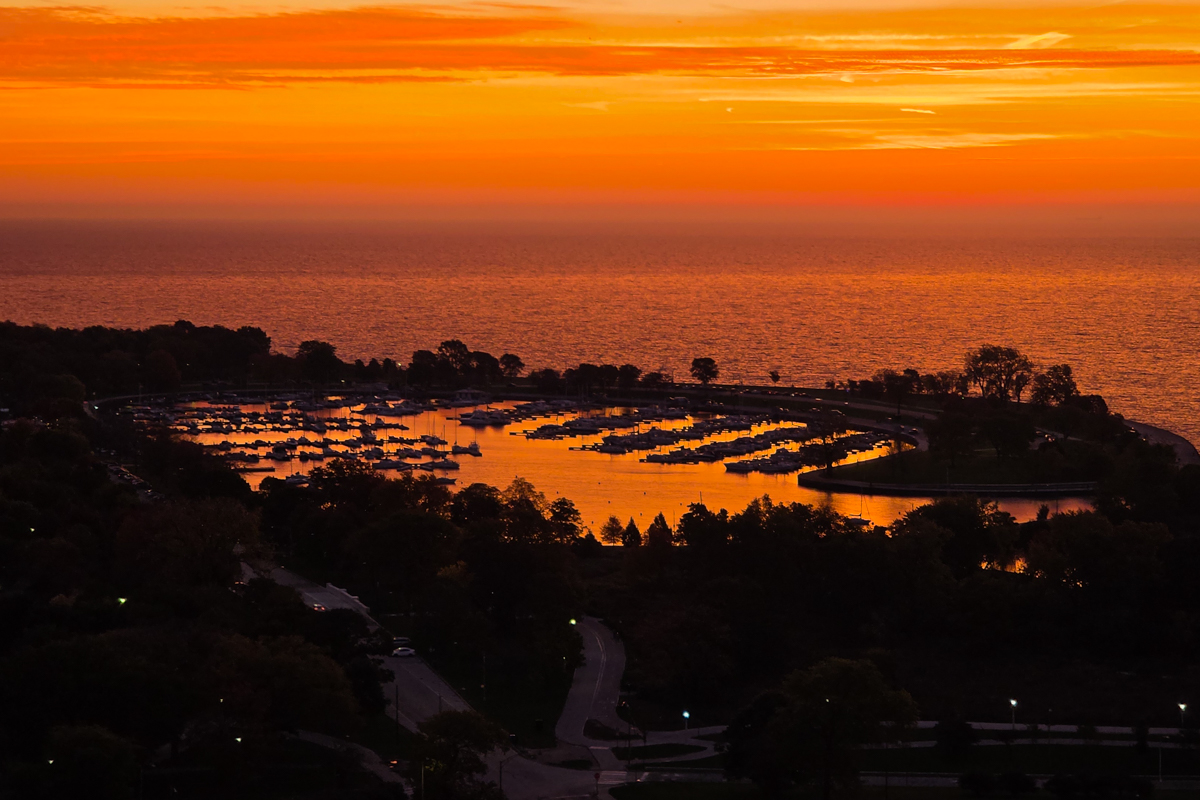
As threatened promised, here are a couple of photos from the weekend. First, sunrise yesterday:
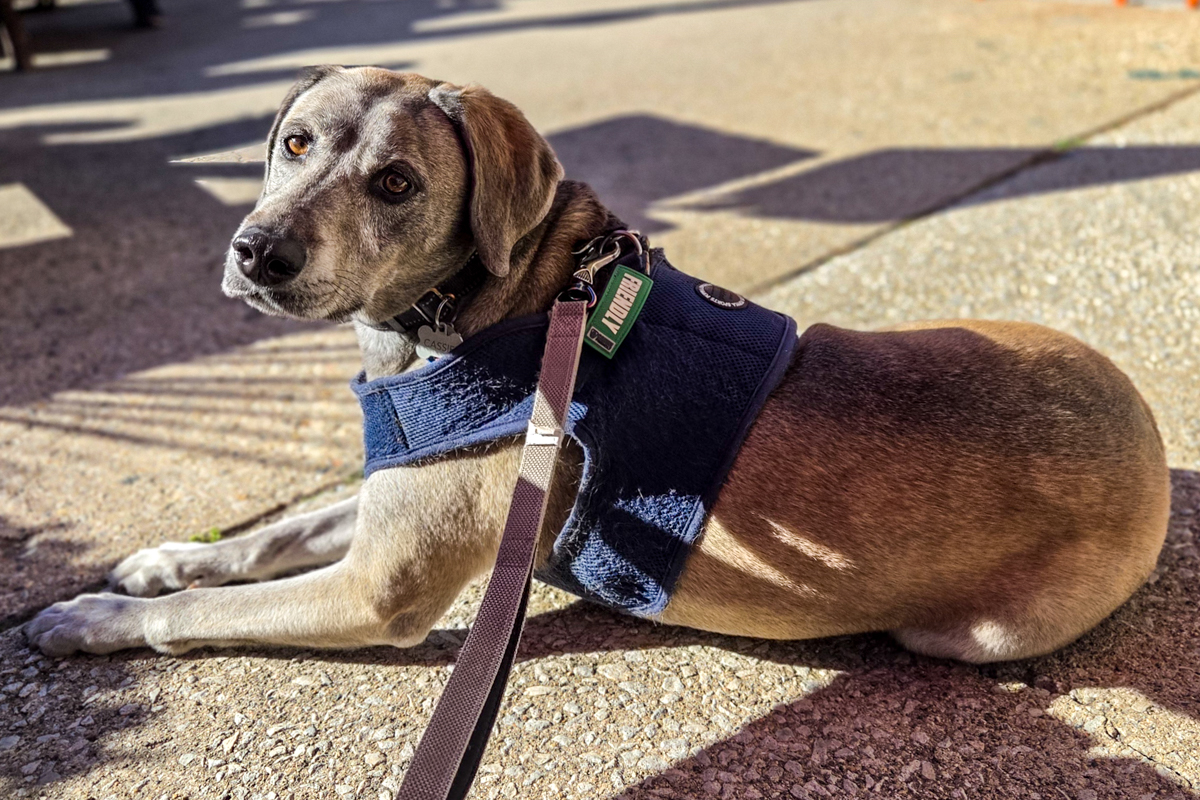
Second, Cassie at Horner Park DFA:
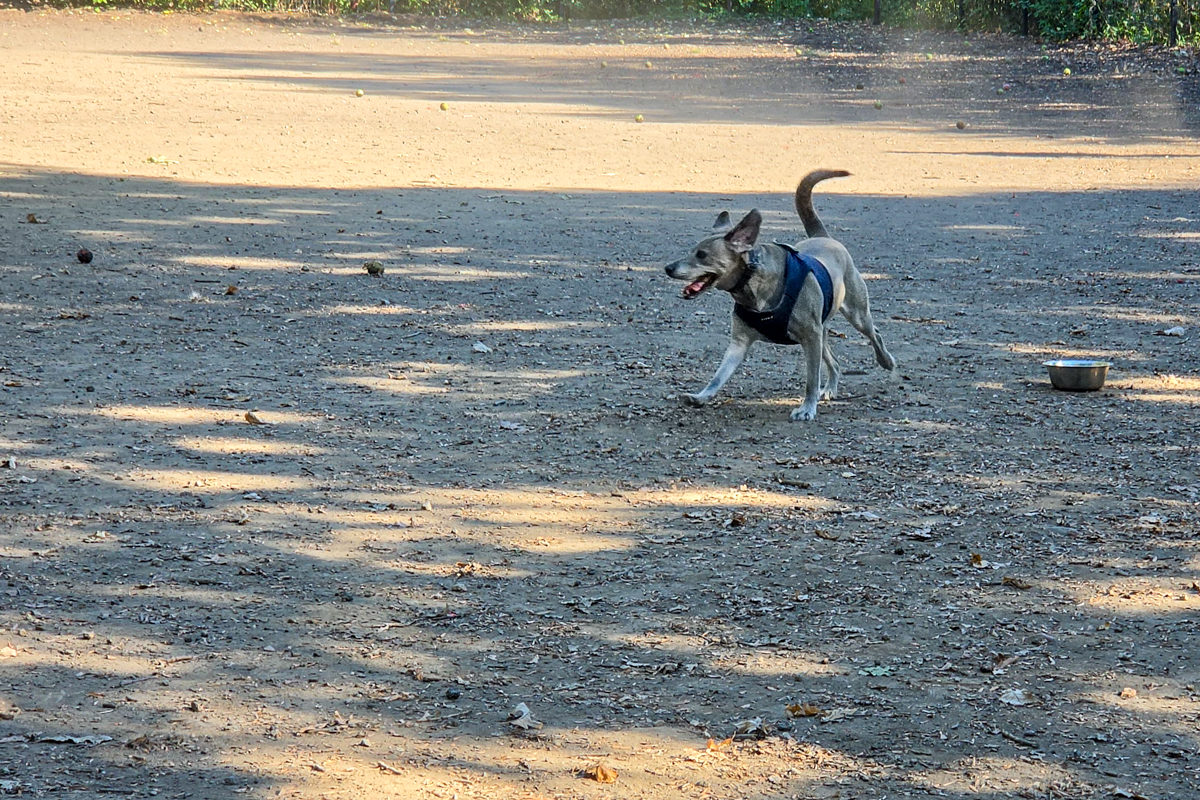
She had a great time. There were more balls on the ground at the dog park than in the entire House Republican caucus. Speaking of those wonderful servants of democracy:
- "Friends don't let friends watch the early vote:" "There’s lots of interesting information in the early vote but not about who is going to win."
- Right-wing candidates in Brazil and Serbia lost elections to the center-left, to the great joy of democrats everywhere.
- Michael Tomasky peers into the rotting Swiss cheese inside the OAFPOTUS's skull and concludes he wants his own party to lose next week's elections for his own personal gain. ("For a president to say 10 days before an election that he doesn’t give a damn that people are paying high prices—which is what he said, no matter how his apologists try to spin it—is, well, unusual.")
- Brian Beutler once again chastises the Democratic Party for downplaying the OAFPOTUS's threat to democracy this close to the election.
- Matt Yglesias chastises the party for really annoying fundraising.
- A federal judge has ordered that Maurene Comey be reinstated as an assistant US attorney following her unlawful firing last year.
- The FAA has certified Boeing's 737-10, an airplane that is finally cost-competitive with Airbus's A321neo.
- Chicago's far north side Rogers Park neighborhood will soon get self-cleaning restrooms in hopes of getting people not to shit on the sidewalk.
Finally, today is the 40th anniversary of Bill Buckner's fielding error in game 6 of the 1986 World Series that allowed the Mets to win and forced a game 7, which Boston wound up losing. Astute baseball fans noticed that Buckner was a former Chicago Cub, playing for the almost-as-cursed Red Sox, so some kind of error was almost inevitable. That said, Buckner didn't lose Game 6; pitcher Calvin Shiraldi gave up two runs in the bottom of the 10th, which relief pitcher Bob Stanley followed up with a wild pitch that put a runner on third.
Buckner played 2,517 games, scored 1,077 runs, stole 183 bases, and had a .991 fielding percentage (only 128 errors in 13,901 chances), which is one of the highest in history (and higher than anyone's in the 2026 season). That's quite a career.
Still, if you were alive and a baseball fan in 1986, you will never forget that error.
Pinned posts
- About this Blog (v5.0) 2 months
- Brews and Choos project 3 weeks
- Chicago sunrises, 2026 9 months
- Inner Drive Technology's computer history 2 years
- Logical fallacies 7 years
- Other people's writing 6 years
- Parker Braverman, 2006-2020 5 years
- Style sheet 1 year
- The 30-Park Geas 2 months
- Where I get my corn-pone 8 months
Cassie and I recorded 19.73 km (12.3 mi) of walks over 4.67 hours this past weekend (thanks, Garmin!). This was only part of me getting 131,451 steps and 109.9 km (68.3 mi) of my own last week. That's a lot of steps.
I will have photos later today, but at the moment I'm doing all the things I didn't do while spending all that time outside yesterday and Saturday.
I also have a rehearsal in Park Ridge tonight, and two jabs scheduled for this afternoon, so the bug fix deployment will probably have to wait until tomorrow.
Non-euclidian geometry and Trader Joe's parking lots
The Daily Parker patch release is (probably) ready for deployment to Production, but I'm going to let it stew in the dev/test environment for a few hours. This is mainly because it's 21°C on the last Sunday in October (shout out to everyone else in the world who changed their clocks today!), so Cassie and I want to go to the dog park. The dev/test environment isn't the only thing that's cooking: I have a batch of pasta sauce in the slow cooker.
Before I go, the Chicago Tribune has ranked all 22 Trader Joe's parking lots in the Chicago area on the eve of the new store opening in my building:
A Trader Joe’s parking lot, typically, is crowded. Spots are tight, and there are rarely enough. All vehicles, big or small, get limited room to maneuver — in fact, the tempers of anyone who decides to park here will rise in inverse proportion to the snugness of the lot itself.
Navigating one on a Sunday afternoon is to be thrust into Tetris. One Instagram user compared the experience to solving a Rubik’s Cube, “except you’re colorblind and in a straightjacket.” Ernie Wong, president of Chicago’s Site Design Group, a landscape architecture firm known for its work on the Riverwalk, the Old Chicago Post Office, Pioneer Court at the Tribune Tower, and plenty of Chicago parking lots, told me: “I drive to Trader Joe’s on Roosevelt, and I hate that parking lot. And yet I will do it! I mean, I do do it! I feel I am a patient parker, I wait my turn, but look, it gets stressful, so I wonder: Is there a value to the amount of stress Trader Joe’s parking lots create in me?
The Lakeview store on Lincoln Avenue (No. 16), the first Chicago location, somehow manages to be both welcoming and cramped — weekend standoffs here between motorists vying for the same space have been known to involve crying. ... Rational thought has no home in the Evanston lot (No. 21), which is microscopic, self-contained and only accessed amidst traffic flying down Chicago Avenue. ... Still, absolute hell on Earth, the final boss of Chicago-area Trader Joe’s parking lots, the true pit of despair, is found at Trader Joe’s off Clybourn Avenue in Lincoln Park (No. 22).
I should point out, this is on the eve of a new Trader Joe's opening in my building, possibly within the next two weeks but almost certainly before Thanksgiving. I have seen where the Joes have marked out parking spaces in the former residential lot on the bottom two floors of our 3-story garage, and I am afraid. I have a feeling getting in and out of my own parking space on the third floor will not be fun during opening hours.
Still, it'll be great to do my grocery shopping without going outside this winter...
OK, dog and man are off.
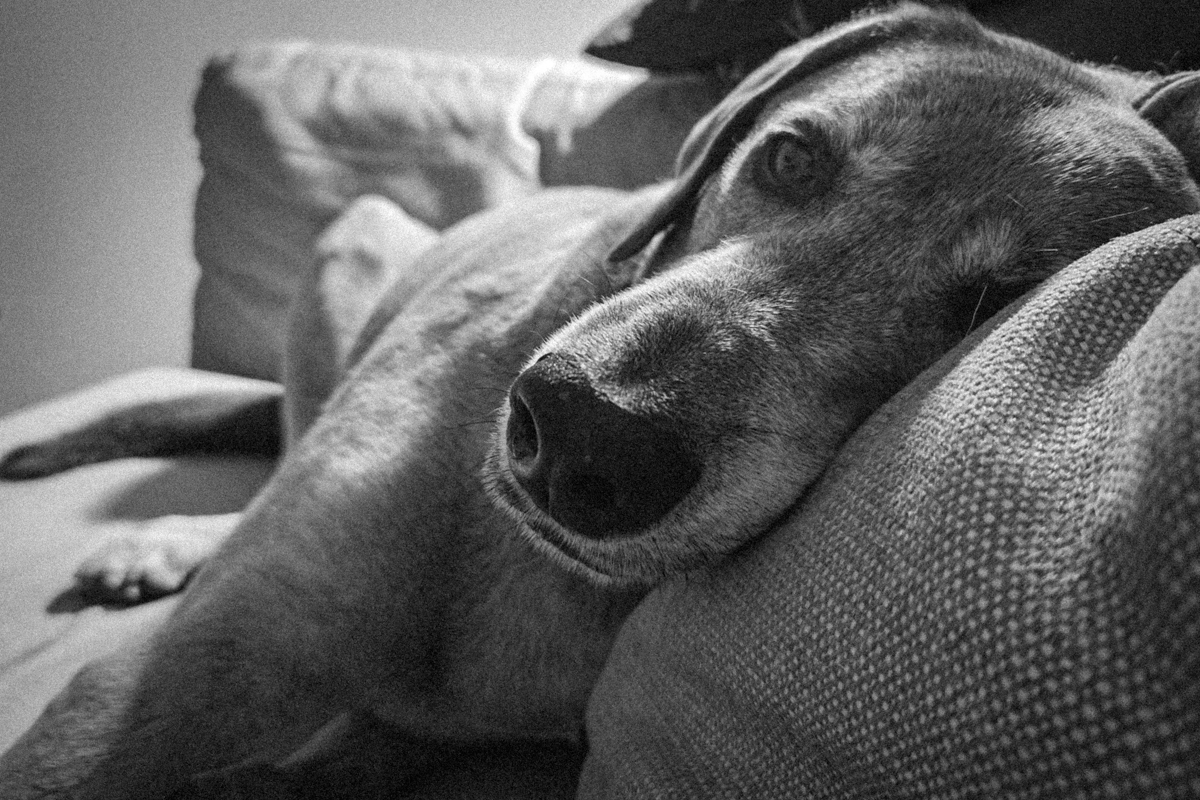
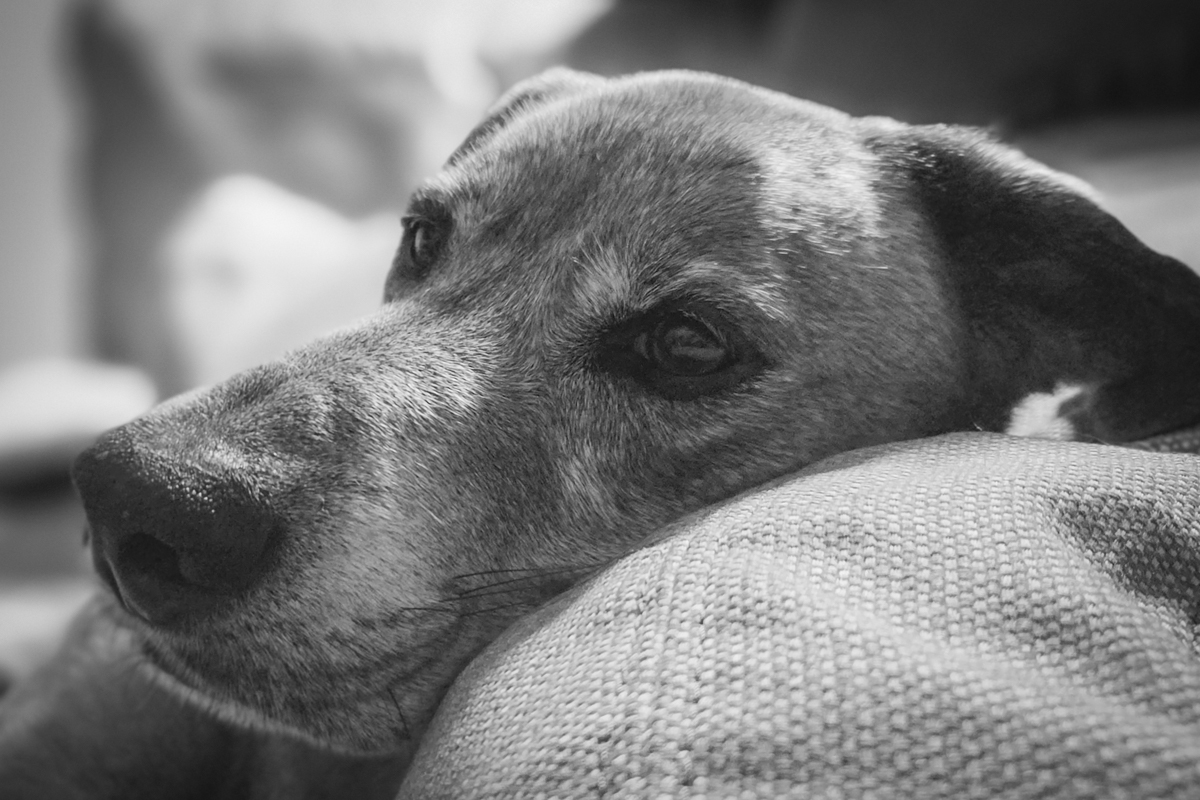
We received a feature request for more Cassie photos. Et voilà:
The bug fix is now churning through the dev/test CI pipeline.
While part of my brain is debugging an annoying new behavior in this software, another part of my brain can't help think about a bit of local news.
It seems a local chicken restaurant known primarily for its Buffalo wings and locally-grown breasts has gone tits-up:
After 35 years, the Hooters restaurant in River North has closed.
The location first opened in 1991 at 660 N. Wells St. The company cited increasing development and neighborhood changes, which a Hooters spokesperson told NBC Chicago led it “to the difficult but considered decision to leave this location.”
Hooters did not comment on the allegations that many of their birds are enhanced with saline injections.
No need to mourn, though. Hooters still has at least 8 locations around the city and suburbs, plus two "hoots" locations if you just want the wings.
The Journal has thrown hundreds of harmless exceptions, almost all of them TaskCanceledException, over the past three days. I'm not entirely sure why. So there might be a patch coming out this weekend.
If you notice anything hinky while visiting the blog, please leave a comment.
(Spoilers for a couple of 30-year-old television shows, and one that's 40 years old. No real Discovery spoilers, though.)
For the past two weeks, I have thought of watching the next episode of Star Trek: Discovery season 4 in my queue, and then said "nah." I believe I've finally figured out why. This is hard for me to admit as a lifetime member of the Democratic Party who has championed progressive causes his whole life, but: it's too damn woke.
Back in 2020, some of you may recall, I wrote a long essay about how Discovery's third season irked me. My principal objection was that a warship popping 900 years into the future would be so disorienting to the crew and to the world it found itself in that the way the series glossed over it undermined the stories the series was trying to tell. I know that this comes close to the Dune joke going around about how fans accept magical space worms and superhero desert warriors but they find a main character named "Duncan Idaho" beyond the pale. It's actually not that far off, though: the way everyone in the 32nd century just blithely accepts the arrival of an ancient ship crewed by uncouth and incomprehensible people took me out of the storytelling.
I got through Season 3 anyway, and it was fine. Not great, but it entertained me while working from home during the pandemic.
Six years later, I realized I never started season 4. The show wrapped for good in May 2024 after season 5, so at least I wasn't falling farther behind, but I still thought I should catch up.
First, I had forgotten a lot about season 3, so I had to review Wikipedia to remember what I'd seen five years earlier. I also pushed aside my objections to the 900-years-in-the-future story and just went with it. But almost immediately in the first episode, season 4 started bothering me even more than season 3 did, for an entirely different and even more perniciously ahistorical reason.
Not only does season 4 continue to ignore the 900-year problem, but it plants itself so squarely in the politics of 2021 America that its politics get in the way of its storytelling. That's bad in any genre, but egregiously bad in sci-fi.
If you've read almost anything I've ever written here, you know that I have absolutely no objection to people or fictional characters on the basis of their demographic characteristics. What I have objected to is when people or fictional characters are solely and entirely concerned with their culture or background to the exclusion of anything else. And I think the contrast between the original Star Trek and this spinoff series illustrate the problems pretty well.
The original Star Trek was one of the most progressive series on television when it ran from 1966 to 1969. It shocked audiences in September 1966 to see a Black woman, a green-blooded alien, and (from season 2) a Russian all serving as bridge officers on the Enterprise. But here's what Gene Roddenberry did that made it work: nothing. Lt Uhura was African, and in-universe, no one cared. That was Roddenberry's point. Of course the future military would have officers from all over the Federation, and of course the other characters wouldn't even notice any more than the US Navy in 1966 would have noticed its officers' eye colors.
Showing that race, sex, and even planet of origin were beneath notice in the future demonstrated a progressive vision that made Star Trek such an enduring franchise. McCoy calling Spock "green-blooded [and] inhuman" in Star Trek: The Wrath of Khan was funny because it was an over-the-top insult in-universe. It would be like me calling a friend a queer Roundhead villain ("yes, I have a same-sex partner, support the Parliament over the King, and was born in a farming community; and?").
Don't get me wrong: the original Star Trek had some howlers of politicking, like "Let This Be Your Last Battlefield" whose ham-handed message made eyes roll in 1969 as much as it does today. And like a lot of men of his generation (I'm looking at you, Isaac Asimov), Roddenberry's progressive vision somehow didn't fully include women. The Star Trek franchise didn't really address that problem until after he died, when Voyager finally gave us a female captain as a lead character.
Let's contrast that with how Discovery handles the issues of the day. The protagonist of the series is a Black, female officer who becomes captain of the ship in season 3. Cool. No one in-universe cares about her demographics, as it should be. Her story arc is compelling, the character is strong and respected by all, and Sonequa Martin-Green is fun to watch. There are some choices about how the character is portrayed that one could see as drawing attention to her being, well, Black and female, but none of it distracts from the story.
Unfortunately, there are four characters whose identities completely overshadow their characters, in really ennervating ways: the doubly-trans Adira Tal (Blu del Barrio) and their deceased um-friend (?) Gray Tal (Ian Alexander); and the gay male couple Paul Stamets (Anthony Rapp) and Hugh Culber (Wilson Cruz). Both relationships hammer the orientations and identities of the participants and distract from the storytelling to a point where I don't even want to deal with them anymore.
Let's take the first pair: Adira and Gray. Both characters are of a symbiotic species (the Trill) in which a worm-like symbiont that lives for centuries rides around in an otherwise normal humanoid body for a few decades until the host dies of old age. The symbiont, being a worm, is just as comfortable in a female humanoid body as a male one. This was understood when the species was introduced in 1993 as an expy for gay and trans people. Deep Space Nine made lots of references to the fact that the Dax symbiont inhabiting the very attractive Jadzia (played by a very attractive 28-year-old Terry Farrell) had previously inhabited an elderly male body named Curzon. But no one cared, with the main character (Ben Sisko, played by Avery Brooks) often warmly addressing Jadzia as "old man."
But with the Adira and Gray storyline, the fact that both del Barrio and Alexander are non-binary is the point. Their scenes lean into this so hard that they often fall over. Like much of the far-left poltics of the 2020s, there is no subtext; it's all text, boldfaced and underlined. And their entire storyline feels to me like a Very Special Episode from a 1980s sitcom.1 The Paul/Hugh storyline at least has some good stuff about how Hugh was dead for a while, and how that affected their marriage; but there are still way too many beats where I imagine someone running a chyron with "They're gay! And married! Look how progressive we are!"
Attention Alex Kutzman et al.: Babylon 5 had two explicitly gay relationships2 back in 1997, both of which flowed directly from the characters and the story rather than the other way around, and in which the homosexuality was completely irrelevant to the story and to the other characters.
The problem, of course, is that Discovery takes these stories from the politics rather than from the characters. It reduces the characters to their contemporary identities, which science fiction has always tried to avoid. And it's just bad storytelling.
Science fiction's greatest strength has always been to frame a contemporary concern in a fantastic way to get at the essence of the issue. In 1966, the Civil Rights Act had just passed, but Black people were still treated as second class in much of the United States, and women of any skin color couldn't open a bank account without their husband's consent. In that context, having a Black female bridge officer on a spaceship, and having no one on that spaceship even notice she's Black or female3, was a groundbreaking statement. In 1996, during "Don't Ask, Don't Tell" and the earliest stirrings of the gay marriage movement, having two women fall in love on a space station, and having no one on that space station even bat an eye over it (at least until Talia's true nature came out, but that had nothing to do with her sex!), was a groundbreaking statement.
In 2021, having a non-binary character fall in love with another non-binary character is about as groundbreaking as one of Cassie's turds.
Kutzman and company clearly did not understand those lessons when plotting out seasons 3 and 4 of Star Trek: Discovery. I'd love to find out that it was really executive meddling, but even still, I'd hope the Discovery writer's room could have found better ways of handling it. Because, after a few episodes of season 4, it just seemed like pandering to a contemporary activist group at the expense of what could have been a much more entertaining series.
Someone please tell me: does it get better? Should I watch the last 15 episodes of Discovery? Or should I just call it a day and return to grown-up sci-fi like The Expanse?
-
Who can forget the Family Ties episode when Alex Keaton tried cocaine? Oh, man, that one still makes my eyes roll 40 years later.↩
-
I refrer to the real relationship between Susan Ivanova and Talia Winters, and the later sham relationship between Marcus Cole and Steven Franklin that enabled them to travel incognito to Mars precisely because it was no big deal. It wasn't even lampshaded; the two characters make jokes about being married because they were friends and could poke at each other's personalities, not because they were both men. Nobody cared, which was a pretty bold statement about same-sex relationships in 1998.↩
-
At least not until Roddenberry found a way to portray the first inter-racial kiss on prime-time television. But the characters didn't care about each other's race, especially since they were both being meat-puppeted at the time.↩
Not the recovery I'd hoped for
Yesterday's long walk felt great at the time, but I did not recover well overnight, so I'm taking it easy today. I've got two meetings this afternoon, a rehearsal this evening, and I sincerely hope a nap before all of that. Plus, despite the horrible things my quads and glutes are saying about the state of the world right now, I do have to take Cassie outside a couple more times.
Speaking of the deplorable state of the world:
- We all knew Ohio Republican gubenatorial candidate Vivek Ramaswamy was a vile lump of dingo feces, but it now seems we didn't know just how putrid he is.
- Alberta spent C$125 m holding a referendum on leaving the federation, which, fortunately, failed. Meaning the OAFPOTUS failed. Again.
- Brian Beutler argues that the Democrats need to play the same expectations game as the Republicans: "They’re on track to win, and they should act like it. But whatever the outcome, they will achieve it against concerted efforts by Donald Trump and his tech-media allies to cheat."
- Part of the OAFPOTUS's lowest-ever approval numbers might have something to do with how he's destroying Americans' health care.
- After FiftyPlusOne investigated hinky polling numbers, they discovered that the "pollster" Wedgewood made up all their polls, possibly as a way to bolster Republican chances in two weeks by nudging Democrats to unpopular far-left positions.
- A new proposal by Chicago area heavy-rail authority Metra would boost rail service throughout the area and take a fully-regional approach to train scheduling. It's at least a decade away from being realized, but it suggests that maybe, just maybe, I will live long enough to see Northern Illinois rail service that's almost as good as 1990s London or even 1970s Tokyo. A guy can dream.
Finally, the guys who bring us The Daily WTF have made a video dramatizing a sequence of hilarious status messages sent out by a software tool company after Amazon Web Services accidentally shut down their entire product line for four days. It's worth 7 minutes of your time:
I did my annual marathon walk today, covering exactly 42.23 km in 6:34:32, which is probably good enough to do Chicago next year (weather permitting). We had a perfect day here in Chicago, with temperatures barely getting to 21°C towards the end of it.
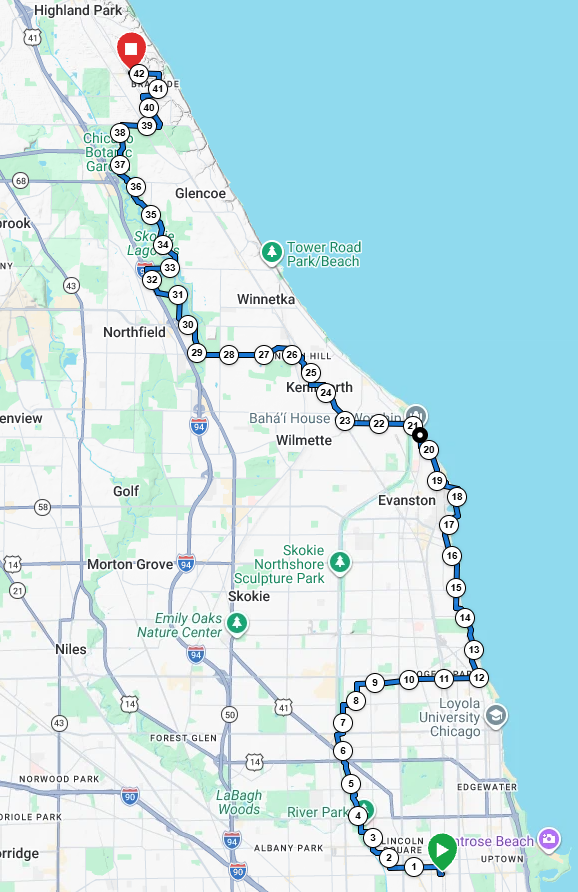
This year we finished at Steep Ravine Brewing owing to the unfortunate demise of Lake Bluff Brewing last month. This allowed my Brews Buddy and me to redo the route from scratch. We agreed we wanted to walk along the Evanston lakefront and Northwestern University lakefill (their artificial lagoon and peninsula), and we wanted to spend some time on the part of the North Branch Trail, which now connects all the way to Ravinia Park and the Lake County McClory Trail, which only took a century, but hey.
I believe I will sleep well tonight. And since Cassie was at day camp for 8 hours, I expect she will as well.
More tomorrow. Right now: I need to lie down.
It was sunny and not too cool yesterday, so Cassie and I spent almost the entire time outside. We walked 13.4 km (8.3 mi), not including the illegal off-leash time I gave her in a North Center park, and spent our breaks at two of my favorite breweries. Unfortunately, Burning Bush was out of Marz crack-and-cheese-covered popcorn so we had to make do with Goldfish crackers.
I also wound up sharing half a beer with a very drunk wasp:

(You can tell it's a wasp because it's not wearing a yarmulke.)
Today is also sunny and cool, so we're about to do our lunchtime walk. And tomorrow, my Brews Buddy and I plan to do our annual marathon walk, though not to Lake Bluff Brewing, because they have ceased operations. Instead, we plan to take a winding path through the North Shore that ends at Steep Ravine Brewing, where we will consume many tacos and get back to Ravenswood in time to ransom both dogs from day care. Updates as conditions warrant.
Driving home from Janesville, Wis., yesterday, I got caught in some light single-cloud rain right before sunset. That's exactly the phenomena required to create this delightful optical effect:
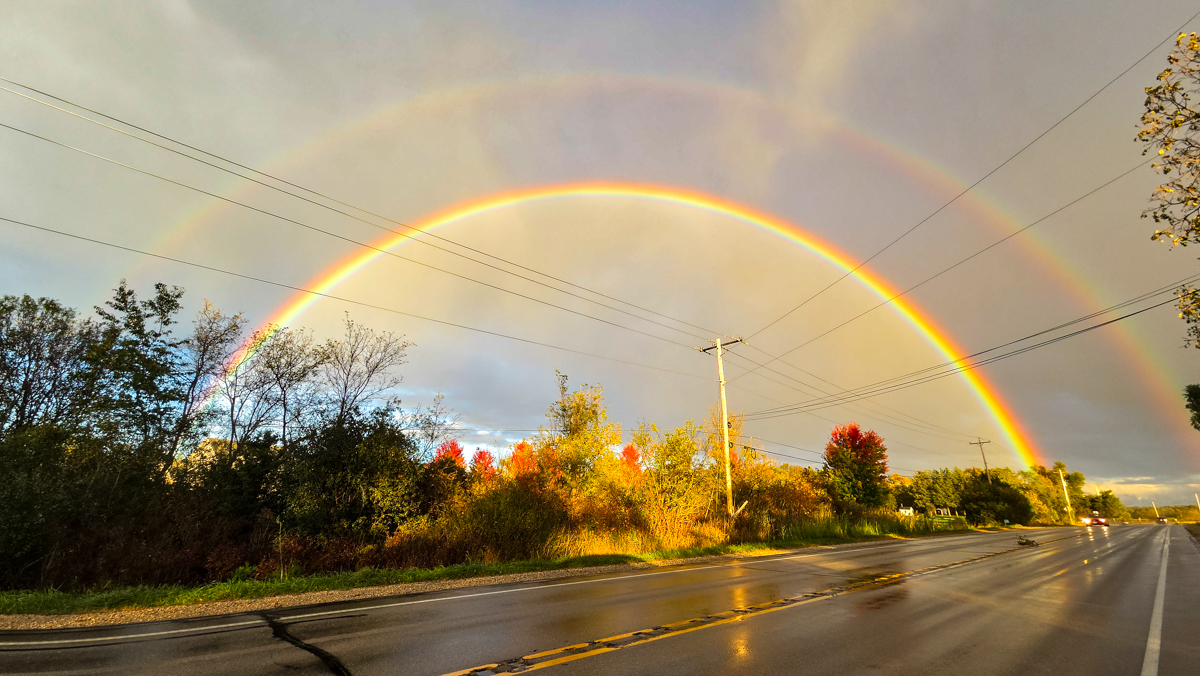
The rainbow "followed" me for about 15 minutes until the cloud drifted south of me. It's unfortunate that a photograph can't capture exactly what I saw, but I had to try.
No main post today as I'll be in the car for 5 hours today, with a memorial service in the middle. Regular posting should resume tomorrow.
Dear DB Vertrieb GmbH Fahrpreisnacherhebung:
I received your letter of 24th September yesterday. In the letter, you claimed that I have not paid the 60 € penalty fare for taking the wrong train from Bruxelles Midi to Liège on 7th September, demanded that I do so immediately, and you assessed a 7 € "reminder fee" to boot. Thank you for providing your international banking information in case I wanted to spend the $50 or so necessary to wire you the money. Regrettably, I cannot comply with your request, as your correspondence had several deficiencies that make it impossible to do so:
- I have already paid the 60 € penalty fare, directly to the conductor of the train in question on 7th September. I am happy to provide a copy or photo of the receipt. That your systems didn't connect that payment with the data the conductor collected on me is unfortunate, but not a problem that I can solve or take responsibility for.
- The United States Postal Service made a heroic effort to deliver the letter, correctly determining that the city of "VI IL CHICAGO CHICAGO" was not, in fact, in the unincorporated territory of the "Amerikanische_Jungferninseln" (the U.S. Virgin Islands), but was rather in the State of Illinois. Unfortunately it took three weeks for them to do that, so I was unable to respond within 10 days as you requested. (I am glad I don't live in one of the 91 poluplated places in the US called Springfield or it might have taken even longer.) You may want to remind your conductors (who in general have excellent English skills) that "VS" is the correct German abbreviation for my country.
- The letter does not list a phone number or email address to which I can direct my response. Given the delivery timeline and difficulties already mentioned, I am loath to respond by post. I hope someone in your Frankfurt am Main office reads The Daily Parker.
Your ICE trains are excellent, and I do look forward to taking another one through Germany someday soon. I just hope we have all moved on from this misunderstanding by then.
Sincerely,
/s/ The Daily Parker
Reading day
I'm waiting for the go-ahead on two already-approved projects with two separate clients, and I don't really feel like banging my head against a 3rd-party API to advance a story I've been working on for this app, so I'm going to catch up on my reading today. I've also got a lot going on this week, including two rehearsals, Don Giovanni last night, and my 103-year-old great-aunt's funeral in Wisconsin on Friday. Even tomorrow I've got an annoyingly-timed meeting that will interrupt my evening, but that sometimes happens when working with a client whose Sydney, London, and Boston offices are all involved in the same project.
Meanwhile, with only 20 days until the election, the OAFPOTUS and his droogs are failing even harder:
- Federal immigration agents raided the home of US Representative Ilhan Omar (D-MN) on a pretense so dubious people are wondering if someone lied to a Federal judge, made even more dubious by trollwife Katie Miller posting (and then deleting) a message basically admitting it was a personal attack on Omar.
- Anne Applebaum is seriously weirded out by the OAFPOTUS's long-established adoration of Russia.
- After the Republicans get routed in three weeks, how much damage will they do to the nation out of spite?
- Who could have guessed that the Clown Prince of X illegally destroyed vast swathes of the US government so that he could steal even more money from us? I am going to buy so much popcorn for the hearings that start in January...
- Despite overwhelming evidence that the men surrounding the OAFPOTUS are orders of magnitude more corrupt than the women, the administration continued its ongoing purge of the "skinny white women"1 who have disappointed them. This time it's yet another trollwife, or at least ex-troll-fiancée, Kimberley Guilfoyle, asked to leave her post as Ambassador to Greece because she asked a buisness owner to pay off her $100,000 Amex bill. Note that it was not because she was selling access to the State Department and Greek diplomatic contacts; it was that she sold it for what the men in the administration viewed as "girl stuff" (i.e., shopping).
- After we take back the House of Representatives, and possibly the Senate, we need to ruthlessly expose the bad acts and corruption of this clown car so that we can make a recurrence of this civic vandalism less likely in future.
- Chicagoans will also vote for our first-ever elected school board on November 3rd, despite most voters not knowing who's funding the candidates
- Remember that time white supremacists staged a violent coup against the elected government of Wilmington, N.C.? You should.
Finally, today is the 100th anniversary of Winnie the Pooh for all you Eeyores out there. It's also the 960th anniversary of the Battle of Hastings, fought only 35 km from Ashdown Forest (aka the Hundred Acre Wood). Imagine if King Harold had a Tigger in his cavalry that day...
-
Seriously, read and follow Daniella Mestyanek-Young. She understands better than almost anyone else how the cult of the OAFPOTUS works and how it can be brought down.↩
Part of why enshittification happens is economic consolidation: large companies buy up small companies until there are so few companies that they don't really compete. We're at peak merger right now because the Democrats are weighing conglomerates twice and finding them lacking: when we get control of the government (my bet is on 2031 but it could be sooner), we're cracking trusts.
At least we still have some rudimentary anti-trust protections, which is why Kroger and Albertson's didn't get to merge. The effect of that merger on much of the Midwest would have been absolutely horrific. In Chicago, for example, the two chains dominate grocery sales, with most of the city's Mariano's (Kroger) locations slated for closing had the merger gone through.
Both store chains have reputations for low prices, especially compared with Whole Foods Market, owned by Amazon. I'm here to tell you that these reputations are unfounded, and I believe they come from the perceptions that Jewel-Osco's and Mariano's stores are cheap, while their prices are nearly the same as Whole Foods'. Also, Mariano's and Jewel-Osco both sell mass-market products that Whole Foods doesn't sell, so people who want, say, a $2 can of Spaghetti-Os will only find a $5 can of something actually from Italy at Whole Foods.
I'm not going to publish reams of data on like-for-like comparisons; those exist elsewhere.1
Trader Joe's and Whole Foods have cleaner stores, wider aisles, more working carts, ample numbers of handbaskets, and have big, old-fashioned paper bags if you forget to bring your own. They also have better lighting, more attractive displays, and better produce. But there are things you can't get at TJ's or WFM that you can only get at a mass-market store like Mariano's, so I have to go there about once a month to stock up.
Jewel and Mariano's are also wildly inconsistent. The Jewel closest to my house is unacceptable except in emergencies, but the one over on Lincoln just below Montrose is fine. Mariano's tend to be a bit better and more consistent, but they're still not nearly as pleasant as WFM or TJ's.
There's one other thing that Mariano's and Jewel do that neither Trader Joe's nor Whole Foods does: both of the mass-market grocery stores treat people like delinquent children. Observe this self-checkout message, which I see at Mariano's evey damn time I go there:
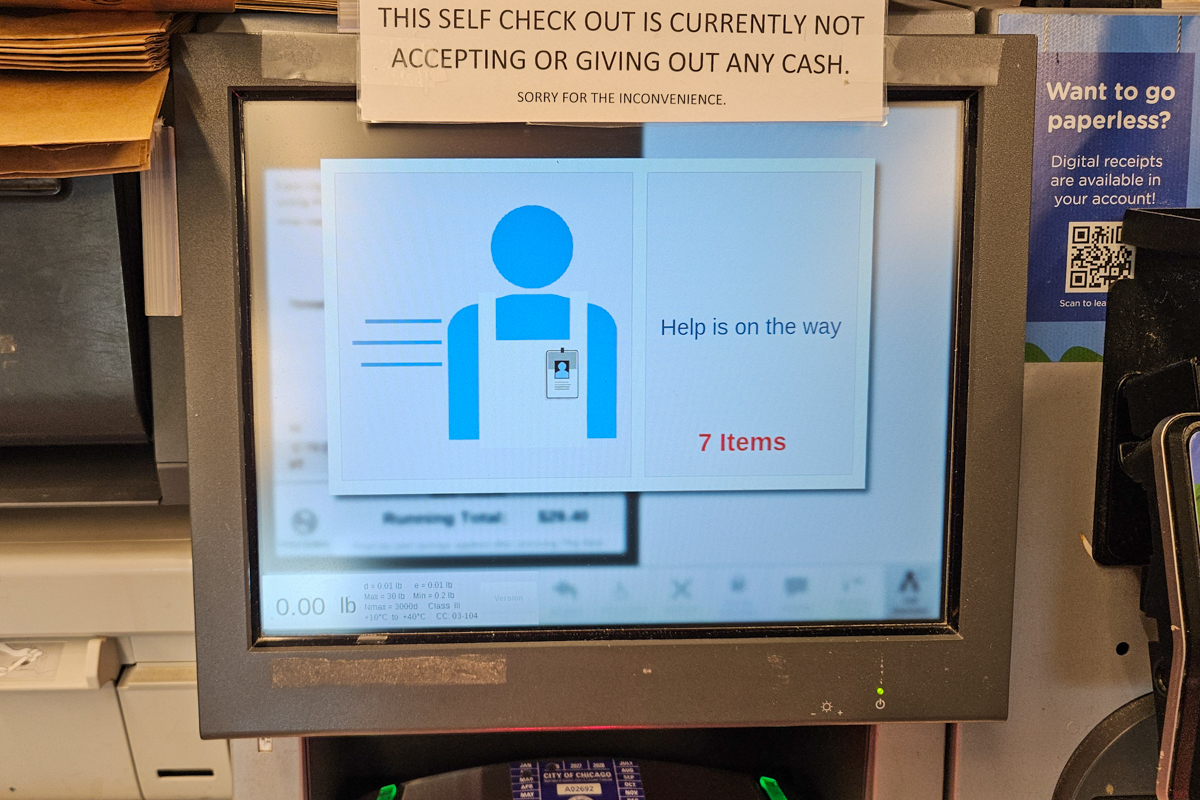
Why was "help on the way?" Because I dropped my shopping list into my bag, and the software decided I was shoplifting.
Jewel's self-checkout behaves the same way. Use your own bag? "Please scan all items before placing them in the bagging area. Help is on the way." Buy alcohol of any kind? Someone has to come over and scan your drivers license. (Whole Foods lets the attendant click "ID valid" and move on. Trader Joe's doesn't have self-checkout, and their checkers are allowed to look at my gray beard and balding head and decide I was born in the 1900s.) Finish ringing things up? Jewel gives you several prompts to donate money to this or that, while Mariano's just wants you to confirm that you've scanned all your items. Then both Mariano's and Jewel take you through the complicated process of tapping your credit card or phone in the right place, collecting your receipt, and of course reminding you not to forget your groceries as you leave! Whole Foods does none of those things, though if you buy anything in a container that you packed, like a salad, the scanner wants to know if you'll be dining here today.
Oh, and if I scan my Amazon app at any time while checking out at Whole Foods, it (a) uses the card I have on file and (b) emails me a detailed receipt automatically. Neither Jewel nor Mariano's does either of those things, even though they track the data anyway through my credit card number.
Trader Joe's uses human beings without a self-checkout option. I have no problem with that, because TJ's also staffs their tills with enough people who have enough training that it's just as fast. Actually, compared with Jewel or Mariano's, it's faster, because TJ's checkers don't have to stop every third item to make sure I'm not trying to steal anything, and TJ's checkers are confident that I am not a drooling simian without the cognitive processing power necessary to figure out how to tap my credit card on the POS device.
Clearly, neither Albertson's nor Kroger cares that I and other non-criminal, functionally-literate people find their treatment ennervating. But as someone who knows how to use and spell the word "ennervating," I want to say to both companies that I absolutely hate going to your stores and will happily drive the additional 3 kilometers to Whole Foods for just about everything I put in my pantry or fridge.
Seriously, with Trader Joe's opening in my own apartment building this Thursday, I might just go there all the time. A two-minute walk beats a can of Spaghetti-Os every time.
-
Consumer Reports found, for example, that Jewel-Osco was the most expensive grocery chain in Chicago, after Trader Joe's, Mariano's, and Whole Foods. All four chains were almost twice as expensive as Costco and up to 36% more expensive than Aldi. Having been to Aldi and Costco, and not spending all that much on groceries as a percentage of my household budget anyway, I'll stick with the big four.↩
Copyright ©2026 Inner Drive Technology. Privacy. Donate!